Monday, November 15, 2010

It was supposed to be a quiet few days...

I was going to start this blog with the story of how my purse got stolen on Friday night, but I no longer feel that it deserves the first story.

I arrived in Fort Portal tonight. It was a 5 hour long drive along an old logging road that twists and turns, and undulates up and down, through the lushest, greenest valleys and hills I have ever seen. The first half of the ride from Kampala to Fort Portal is mostly done on a dirt road, as this highway is undergoing construction to widen it. It has also been raining today, almost incessantly. This means the big trucks are frequently unable to mount the hills. One truck even lost its back axle on a down slope! Thank goodness Dennis and Patrick, two biologists who are kindly giving me a ride on their way to Kibale Forest to study fish, monkeys and trees, are excellent and cautious drivers. We are also sharing the road with crazy Matatu drivers, boda-bodas, cyclists and pedestrians. As the sun sets, identifying any of the above becomes close to impossible.

Papyrus on the side of the road outside Kampala

Swamp lands

Mind the photo quality and the moving car, but this is to give you an idea of the view. It doesn't do it close to justice

Again, the quality is meh, but the depth of the greens in these forests is unreal.


About half way through our trip, we approach a truck overloaded with sacs of charcoal stopped on the side of the road. Not unusual. However, on either side of the road are groups of people, many frantically waving their arms. As we drive through the crowds, on the side of the road is a girl, no older than 3 or 4, lying lifelessly next to her seated, sobbing mother. A dirty cloth barely covers her tiny body which has just been struck by the large vehicle towering over her from the other side of the road. I can see her face, her hair, her mouth... I won't forget them. Please think of this little angel today. She has just become one of Uganda's latest road traffic accidents, and yet her death will likely never even become a count in the rising statistic of the growing trauma burden here. She deserves better, and hopefully now she has found it.

I am sorry to write that first and up front, as the rest of the blog isn't as somber, but she deserved the "front page".

The end of this week for me was a quite a change of pace. Thursday, after a day of interviews and outdoor yoga, the first of the group from UBC arrived to begin their two weeks of trying to improve the efficiency of orthopaedic trauma management at Mulago.

Proof I have not been a couch patato since I left!

 Friday, after a quiet day of research, I agreed to join the UBC group for dinner. We were going to walk to the mall. I hadn't yet done much walking in Kampala at night, but since it was the group's third time here, I assumed it was okay. About 5 minutes away from our destination, as I walked in between two other women in our group of 5, suddenly there was a tug on my bag. I grasped the handle of my bag even tighter, but it ripped right off my bag. I turned to watch a skinny guy with a blue tee-shirt tucked into jeans, run away with my bag into the bushes off the side of the road. I yelled at him and tried chasing him in my adrenaline rush, but I lost my footing in the grass and he was out of sight before I could look up. Gone were my phone, my camera, my glucometer, a small chunk of cash, and some less valuable personal effects. I felt so violated, but was thankful I was safe and that I had lost little of any real value. The group was as shocked as I was. Needless to say, we cabbed back and the group will not be walking at night anymore! In fact, the following night we ate in at the Guest House!

By Saturday morning, a trip to the mall had all my belongings replaced for about 300$. I doubt the snatcher even sold my stuff for that much! Although the my replacement phone rocks and cost me only 23$, cameras in Uganda are poor quality and very expensive. I forewarn you in advance that my upcoming pictures will not be as good! : (

Today, Sunday, the BC group are teaching the local residents and surgeons a basic fracture "AO" course, with sawbones and all. As I wasn't leaving for Fort Portal (pronounced "Foht Pottal" if  you have a Ugandan accent) until 130pm, I went to help. It was fun teaching, but it was a little scary to really see how far behind these residents are in comparison to our programs.

Nancy, head Ortho OR nurse at Vancouver General, and some of the residents at the AO course.
 On the topic of the Ugandan accent, I have noticed that often Ls are pronounced as R type sounds, like Kampara versus Kampala. The laughing stock of the ride to Foht Pottal today was my favorite example of this; I wish I could have snapped a photo. Twice we saw shops with signs advertising their products: Airtime, mobile phone charging, and " REFRESHING CORD DRINKS"!!!!

I am now in Fort Portal to begin my interview tour of the orthopaedic health care workers of Western and Southern Uganda. Before dropping me off at the hostel, Patrick and Dennis took me to the market to get local treats (sim-sim bars (this is local sesame) and banana chips) and then out for a delicious local dinner. The outdoor restaurant dubbed as bar, billiards club, and public living room so one could watch this week's episode of Kenya's version of American Idol. Like most restaurants in Uganda, there are sinks or wash basins along the sides for hand washing. They even come to the table with one in case you don't want to get up. (More upscale places tend to do the hot towel instead.) The food was scrumptious. They first bring out a plate of sliced tomatoes and avocado, the big, sweet and delicious kind! With that comes a plate with minced raw onion, coarse salt and marinated chilis for dipping. Next is the steamed plantain, though I am told this can be casava some nights. Lastly comes the waiter with skewers of roasted pork, fresh from the fire glowing in the distance. He removes the meat to a plate, and then commences your meal, eaten with your hands. Oh, and though there is a full bar here, you can bring your own booze. Dennis had picked up a bottle of great Italian red for maybe 6 dollars which we drank with our meal. Delish!

At the Rwenzori Traveller's Inn, I am waiting for the loud voices to die down so I can get some sleep. At 15$ with breakfast, I am not sure I can expect more. The inn derives its name from the mountain range which towers over this area from about 50 km or so to the West. As the bar sounds like it is closing, I will wrap up too. This week, I will be going town-hopping and so will no doubt have another blog to post soon!

Once again, please take a moment for the poor girl, likely one of many, who lost her life today.

Love,

Maryse

Thursday, November 11, 2010

Monkey Business

I love her little hands!

 It's not just because I got some really cute photos of the monkeys that I am dedicating a whole blog just to them, but their story deserves telling.

On my way back from the hospital after my interviews, the monkeys were out playing again. Lots of babies, lots of tree climbing, tree eating, and one monkey was even spoiled by the neighbour who threw her a banana. The monkeys seems so human in many ways. They have different sounds for communicating, from squeaks to grunts. They sit in chairs (see below). They even know that boys like blue, see the first photo to understand, and that pink is for girls (didn't get you a photo for proof unfortunately!). But most of all, they also go through hardship. Like every other Uganda, they had to live through Idi Amin's rule.


I spy something that is BLUE!

The generation and families of vervets who live by Mulago hospital and have spread into nearby Nakasero, are survivors of Amin. Nelson, the guest house manager, told me their story.

In 1979, as Tanzanian troops invaded Uganda and eventually made their way to Kampala to overthrow Amin, the city of Kampala was in horrific chaos. The medical school across the street from me was abandoned. In the school, they kept a male and female monkey. As no one came to feed them anymore, they escaped. And so they began their family on Mulago Hill.

Although today there are many, this troupe of vervets started off as just two. Thirty years later, they have a large family with two males, multiple females and ever-growing numbers of babies at Mulago, but also have extended families (likely males who were kicked out) in other nearby areas.

I couldn't help but share photos of my dashing little neighbours with you! See, monkeys DO like bananas! Apparently, mangos too!

Adult monkeys like bananas!

Teenagers too!

Mom and a really young baby! They carry them around just like we do... although they can do it hands free!

Monkeys on my doorstep!

My week has slowed down since my last post. I have been conducting interviews for my research on a daily basis. It is reassuring to know that my "developed world" interpretation of what might be a developing world problem was right. Trying to provide essential orthopaedic services without the right tools is next to impossible, and close to criminal in some cases. On the bright side, I walked out of my house last evening to find a family of vervet monkeys in the yard across from me!


This week my exposure to orthopaedics has been extremes. On Tuesday, I attended Patrick's out patient clinic in the morning in his Mulago office. Some of them were post operative patients, some referrals from the ER, and many others were just passersby looking for a doctor with his door open who could help. A positive was learning that physiotherapy is covered by the government here in the public hospital system! 

We then attended departmental rounds. This is when all the surgeons, the residents, medical students, nurses, orthopaedic officers and others I didn't recognize, get together to discuss the happenings of the past week. The chief resident listed the number of admissions, discharges (significantly smaller than the number of admissions), operations (again, significantly less than the number of admissions), and deaths. The problems encountered throughout the week were highlighted: no oxygen in the operating room, no saws or drills in the casualty theater, no beds for admission... the list went on. There was next a large discussion about the UBC group that arrives tonight. There is a group of orthopaedic surgeons who come to Uganda once a year, stocked with implants and tools, to do a straight two weeks of collecting the injured patients as they arrive in the ER and operating on them within 24 hours. The head nurse of the ward however, was concerned. How could they accommodate such a large volume of post-op patients when the ward is currently full with people waiting on surgery. The point was well taken, but it was never decided how they would find the additional bed space.

That afternoon I followed Patrick to one of the many private hospitals in Kampala, the International Kampala Hospital, started by an Irishman. Here we did another outpatient clinic. What a difference! The hospital for one, was as beautiful if not nicer than ours.


The clinic room was well furnished, clean, sunny and had a balcony. There was a nurse just for Dr. Sekimpi who helped run his clinic and handled the fees patients had to pay. Patients got same-day Xrays and OR the following day if needed. Follow-up appointments were no longer than a week away. Patients did not wait more than an hour to be seen. If only we could accomplish that!

On our way back into town, we stopped in the true downtown of Kampala to buy weed killer for Patrick's farm. We got stuck in one of Kampala's notorious traffic jams. One hour to move maybe 400meters! I can't believe I didn't see an accident! It seems the jams are more frequent these days because campaigning is going on for the 2011 presidential elections. Trucks with loudspeakers crowd the streets and prevent traffic flow. There are two short videos on my the web album (link in previous blog), but I thought only to take them once we started moving so they are not a great example of the madness.

Yesterday, I went back to the Orthopaedic OR at Mulago. Although there was oxygen today, there was no anesthetist until 10am. Drills did not work. The drilling for screws was done by hand. A one hour case turned into a two and half hour case. Again, the theater list was littered with injuries  that were months old. It seems the pattern is that patients spend the first month hoping they will get better on their own or with a traditional healer. When they fail to improve or their function worsens, they come to hospital. It takes one month for them to get to the OR. The first two cases of the day were a man with a 3 month long dislocated elbow, and a women with a 3 month old broken femur. Xrays below. Both have been treated, but the lack of tools and inappropriately sized implants do not promise favourable long term outcomes. In the meantime, I will keep my fingers crossed for them.


More interviews today, and since it is sunny out, maybe some outdoor yoga. There is a mat the female physicians have been leaving behind for one another here at the Guest House. I think I am the fourth to use it.

Until next time, Namaste.

Monday, November 8, 2010

A Muzungo's experience


IN CASE THE VIDEOS WERE NOT WORKING FOR YOU, ALL OF MY PHOTOS AND VIDEOS FOR THE BLOG CAN BE FOUND HERE. THANKS! (Nov 11, 2010)

Muzungo: Non-derogatory term in Luganda (most common tribal language here) for white person

In the last two days, I think I have really begun to understand some fundamentals of Ugandan culture and way of life in ways most muzungos who come here do not.

I took call on Saturday night until the end of Sunday morning with two of the local residents. Their shifts here run from 5pm to 5pm the next day, as opposed to the North American way of 7am to some undetermined time the following morning, or if unlucky, afternoon.

I arrived at 5pm to meet the senior resident on call, Yasin. In African fashion, he arrived 45 minutes later. He toured me around the Casualty Department (ER), the Casualty OR, and the short-stay trauma unit which is shared by all surgical services. The casualty department consists of a short hallway and a waiting room which dubs as the lobby entrance of the hospital. There is a VIP room (it is still unclear to me who gets to enter here), a resuscitation room (equipped with 2 beds, one oxygen tank, and portable suction), an X-Ray machine, maybe 4 beds for assessment, and a plaster room. The plaster room is managed only by the orthopaedic officers, and it seems the residents do not have access to it or its supplies. Orthopaedic officers are people trained for 3 years exclusively to treat closed orthopaedic injuries. They do closed reductions and casting. In Casualty, they see all ortho patients first, then send them to the short-stay ward for orthopaedic assessment. Even though we may walk by 1 or 2 people lying with open fractures in the hallway, an ortho resident will not bother assessing them until they are brought to the ward.

The short-stay ward has three sections divided by 6 feet walls. There are maybe 30 beds in here, but as many as needed can be squeezed in to the point that you almost need to crawl over beds to see someone tucked away at the back. There are never more than 2 nurses here on duty. Nurses are responsible only for administering medications, perhaps starting IVs (but residents do this too to save time), and otherwise go to see a patient only if sufficiently begged to by the resident or patient's family. Patient's families are crucial in the hospitalization process. As there are no attendants for patients, if you do not have family to help you, you do not eat, get bed sheets or have anyone to walk you to the one washroom on the ward. I am starting to notice those who do not have families are at high risk of dying. No one takes regular vital signs here or responds to calls of pain or help. This means that if you begin to feel unwell or become unstable and don't have a family member to get help for you, you will decompensate and possibly die, unnoticed.

The OR in the Casualty department has two rooms. It is staffed however, but only one team. If lucky, there maybe be two anesthetists and two nurses. Often the ortho residents are doing their cases with no assistance by nurses, and are lucky if an anesthetist pays even an ounce of attention. The OR here is also poorly stocked. The main ortho ward is not great, but here it is the pits. No drills or saws, and no implants at all. Not even plaster to maintain the reductions you do manage to achieve. The emergency OR for ortho is staffed only by the resident on call, and is used only for irrigating and debriding open fractures and stabilising them if possible. Apparently you can sometimes put pins in by hand. This weekend however, we had nothing to work with. I mean nothing. We made casts and splints out of cardboard boxes and cotton rolls. I performed a below-knee leg amputation with a dull tool, a mallet and mostly brute strength. (Yes, I do have some of that hidden somewhere.)

Although I did have access to a few more tools (uselessly dull saw, dull periosteal elevator used as an osteotome, and mallet), this is more or less all you have to work with. There is not even cautery in this ER operating room.


This is the stock room. At least it has an autoclave. the trays on the counter is all there is for instruments. Behind me is a modest stock of dressings and gloves.
The worst part about the whole system to me however, is watching people who come in with a chance of a full recovery, and yet the delays and lack of infrastructure and tools leave them with devastating results. While waiting for treatment, injuries turn into permanent disabilities and in some cases death. For instance, a man came in with an open forearm fracture. It took almost 8 hours for ortho to see him, as we were operating and there were three other people with open injuries ahead of him. On initial assessment, his nerves and arteries were working, and he was more or less well. Five hours later, lying on an cot with his arm in a cardboard splint, he had lost so much blood his tongue was white and he couldn't even hold up his head. His hand was now paralyzed and he had no pulse. He never complained. 12 hours before, we could have at least casted him, washed out his wounds and given him a chance at a functional arm, now... he is looking at an amputation if he survives at all.

Culturally, the hospital also has a lot to say about Ugandans. Children, even infants, are lovingly ignored if I can call it that. Cries are ignored, kids can walk around on their own and it seems no one watches them. One 8 year old boy with disfiguring burns to his face, was alone on his cot at least half the time. Luckily he seemed to sleep a lot. Families are large. Most women have between 5 and 10 children. Families are close, and when a member nears death, they weep loudly, wave their arms in the air, hug each other, pray, and call out to the gods for help. Interestingly however, it seems the concept of injury and its potential negative and permanent outcomes, are foreign to Ugandans. We explained to a 24 year old boy and his family that his boda-boda accident had left him permanently quadriplegic. No one wept. No one looked anxious. I can't tell if it's that they don't understand (which is what the resident thinks), or maybe they just accept it for what it is. In the last 30 years until recently, anytime you went out you risked get assaulted, raped or killed by Idi Amin's men. Perhaps Ugandans have come to grips with the fact that everyday risks await you, and often you will not recover from them.

On a much lighter note, last night I attended a show by the Ndere Troupe in Ntinda. Jackson, a PhD in biology who works on sustainable renewable resources, fisheries in particular, took me to see this group who performs songs and dances from tribes all over Uganda. I met Jackson though Lauren, a biogist who works with Martin at McGill. The show was spectacular. It took place in an open air amphitheater which was built with the help of the Austrian government. It was very interesting to hear and see the differences among tribes. Here are a few videos to give you a taste. The first one is a dance from the north which calls for peace. The women stack up to 8 or 9 clay pots on their heads and dance around. The second one is a dance from Central Uganda. The men have rattles on their legs. The third one is from Western Uganda, and the last one is also Central Uganda.

Until next time, and thanks to all of you who read my rambling memories of my days in Uganda.


Saturday, November 6, 2010

What rainy season?

For a country which is supposed to be in the height of the rainy season, I am not sure what the fuss is about. Since I have arrived, it has rained for a few hours at most. It tends to rain around 2 or 3 pm for an hour, and maybe once again at night. It hasn't rained in two days however!

I am now unpacked and settled in at the Mulago Guest House. It is prettier than I imagined. Manicured grounds on a slope littered with a half dozen one and two-story guest houses. My guest house enters into a dining and sitting room, equipped tv and stereo, and has maybe 10 rooms. My room is well sized with an ensuite bathroom and even enough room for me to start practicing some yoga! Yay!

Today I will join a resident for the afternoon and evening to see how admissions and surgeries work when on call. Tomorrow evening, Jackson, a biologist at Makerere University whom I met through a McGill professor (Lauren) who studies fish in Uganda, is taking me to the Ndere Cultural Center for their weekly Sunday events. I really look forward to that! Monday marks the beginning of my interviews with surgeons and orthopaedic sales reps. I am hoping to complete my Kampala interviews within a week. This coming Saturday or Sunday, I think I am off to Fort Portal in the west to continue my interviews. There are both mission and government hospitals there. Lauren's colleagues, Dennis and Jackson, have both offered to drive me there so it has worked out well. I may even be able to get a ride back! Jackson is also from the north, a town called Arua, where he has friends who are doctors. He is hoping to set me up with them as well. For my trip south to Masaka and Mbarara, I have yet to find contacts...

Hope all is well at home and should you ever get bored, you can always email or skype me! I am mostly alone in the guest house until Thursday when the group of ortho surgeons from UBC arrive!

Maryse

Pictures! Yay!

This is the Mulago "new" Hospital entrance

The orthopaedic department. The door with the blue sign is Patrick's office where I am doing work from time to time.

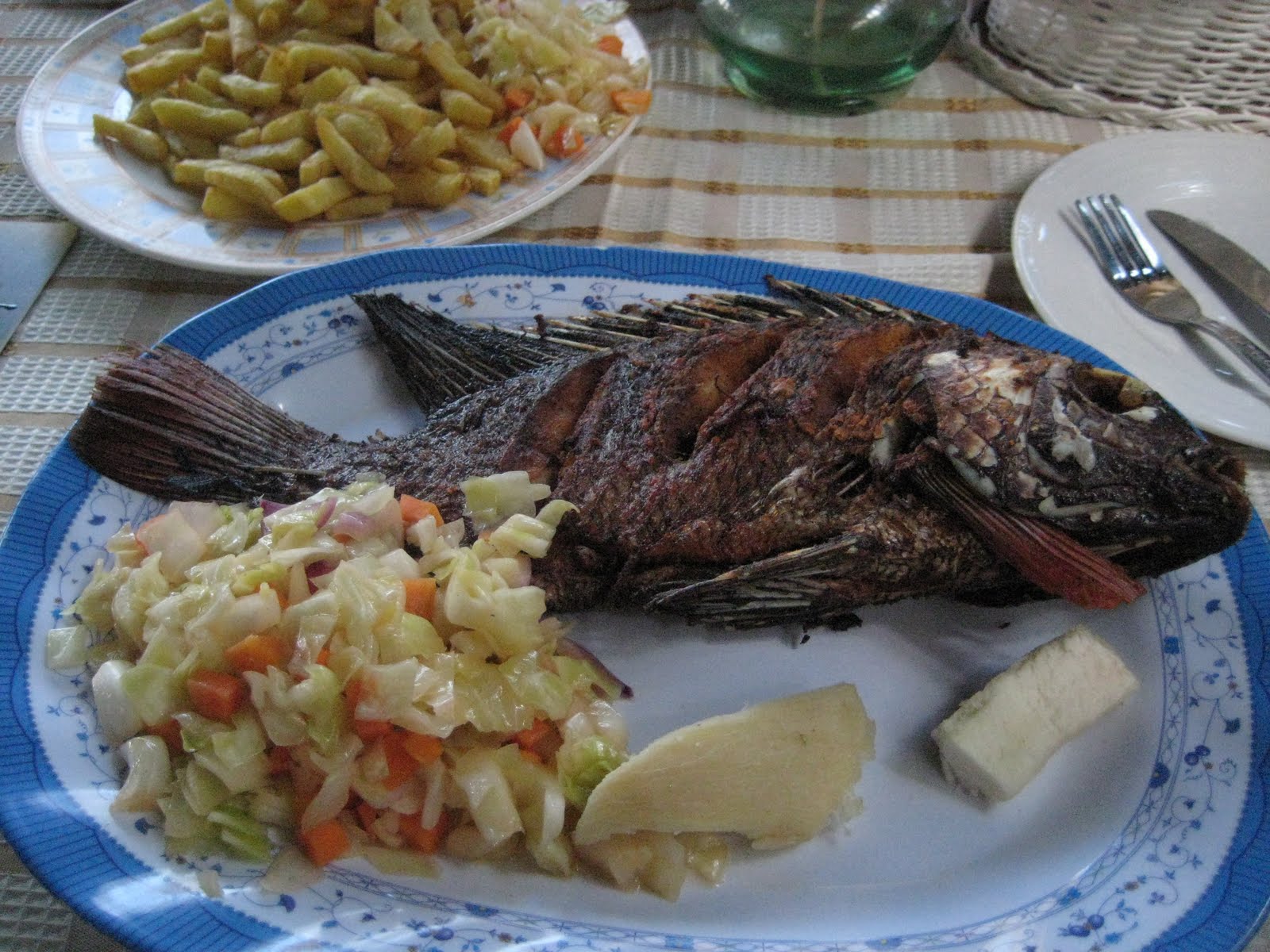
The yummiest tilapia ever... fried, seasoned, fresh from Lake Victoria... MMMmmmmm (Served with casava and salad)

Pineapples from Patrick's farm. Delicious... Not sure if you can tell but they are about a foot long and and 7 or 8 inches wide!

Under the banana tree in Patrick's garden... Isabelle on the left is his 5 year old daughter with her cousin Tess on the right

Miss Samaria is 3 and as cute as a button!

Patrick and Sami by the guava tree

The view of Kisaasi where the Sekimpi's live. The photo is taken from behind their house.

Mom and baby riding side-saddle on a boda-boda on the main road from Patrick's house. The driver has a helmet!

Aside from the major highways and drives downtown, this is a typical Kampala road

I don't know if you can tell how huge this bird is but I felt like had I been walking on the street under it this morning, it would have scooped me up and eaten me! This is a Marabou Stork. Two of them were flying over the highway. I didn't think I was afraid of birds, but I might be now. I;d guess, its wingspan was close to 8 feet!

I have left Patrick's this morning and moved in to the Mulago Guest House. It's is much more beautiful than I thought! This is my room for now. It has an ensuite bathroom! It is across the road from the hospital and up the hill from a market. More pictures of the grounds to come soon.

Friday, November 5, 2010

Driving around Kampala and learning the ropes at Mulago Hospital

My journey to Kampala was simple and hiccup-less.

Arriving at Entebbe airport, Dr. Patrick Sekimpi was waiting for me as promised. We hoped into his Toyota Prado and made for the road to Kampala.

The roads:

There is a reason why Uganda has an ever-rowing number of road traffic accidents. At best, a highway might have two lanes in either direction, is paved and has a wide shoulder. Most city roads are two lanes with minimal shoulder, occasionally paved, and ridden with pot holes. The dirt roads have ruts and pot holes that make you wonder how sedans, matatus and boda-bodas survive it. Patrick says it's no problem so long as you replace your shocks frequently.

Boda-Bodas and Matatus:

Boda-Bodas are motorcycles or scooters. Although sometimes for personal use, boda-bodas are often taxis for up to three or four passengers, and large furniture or bundles of logs. They are great for bypassing traffic. Boda-bodas mostly drive on the shoulder or meander through cars. They share the shoulder however, with many pedestrians and cyclists. Intersections rarely have traffic signals, and stops signs are a mere suggestion. Crossing a junction reminds me of a game of Chicken. Needless to say, two of the three patients I interviewed this morning were admitted for fractures sustained when hit by a car while either driving or riding on a boda-boda. Helmets, though apparently mandatory, are rarely worn, and women passengers tend to ride "side-saddle" holding onto a handle, if present.

The matatus make driving even more exciting. These are the 14 passenger mini-buses which are the cheapest local public transport in town. They stop more or less anywhere along the road, are not terribly skilled at merging, and often drive in the oncoming lanes to avoid traffic.

Luckily for me, as of Saturday when I move to the Mulago Guest House, I will be on hospital property which is gated and has little traffic. The surrounding main roads are also blessed with side-walks. Small joys! Photos to come!


Mulago Hospital:

Mulago Hospital has a rather large campus. The "New Mulago Hospital" is a six story building which has an emergency room, a trauma OR for immediate emergencies which all specialties share, in-patient wards, and out-patient departments. Across the street is the medical school. Dispersed around the hospital, are 16 or so wards which are housed in small one-story buildings. Orthopaedic in-patients are in the Spine Ward and Ward 7 (Orthopaedic Trauma). Each ward has its own OR (1 in Spine, 2 in trauma). The surgeons' offices, resident teaching rooms, and library are in another building just up the hill.

Yesterday I planned on attending the trauma OR. Unfortunately, the OR had run out of oxygen the day before. By 1130am Thursday, the oxygen tank had been delivered to the main hospital. It was not transported to Ward 7 until 115pm. Once it arrived, 3 patients were rolled into the OR bay. It took another half an hour to find the right connection to hook up the tank to the anesthesia machine.

In the mean time I got a tour of the OR. The autoclave for sterilizing equipment has been broken for two years. Everything must get sent to the main hospital. Screws are low in stock, so rod cutters are used to cut them to the right size as needed. Creativity and resourcefulness are key in performing surgery here.

The first patient had a left mid-shaft femur fracture with an ipsi-lateral femoral neck fracture. As the anesthetist assumed cases would not go today, she was out of town. Her second year resident did the spinal. At home, an ideal way to fix these fractures would be a cephalomedullary nail (a rod that goes inside the bone and has  a big screw at the top going into the head of the femur), however they do not have these here. As the patient was older, he got his femur plated and his hip replaced with a Moore's prosthesis. His outcome should still be good.
Cephalomedullary Nail
Moore's Prosthesis

Today, I waited to interview some patients at the residents' out-patient clinic. Imagine a ticket window at a tiny train station in a small town. Imagine the townspeople must all commute to work at 8am, but the window opens only at 7:55am.  In the clinic's tiny waiting area, people in plaster casts rush the window to check in. They are in wheelchairs, lying on the ground, leaning on crutches or family members, or limping independently to the window trying to check in. The residents are 90 minutes late for clinic as they had a tutorial. It is hot, but a TV in the back plays CNN. No one seems angry or irritated. Everyone waits in line and shuffles along as instructed. By the time the residents arrived, it was too chaotic for them to give me a room for interviews.

I ended up speaking to a few patients on the ward. A brick layer fell off a ladder at work and broke his hip. He waited two days before going to the hospital hoping it would improve. Once here, he waited a month for surgery. His femoral head did not survive and so it was removed. He will unlikely be able to continue his profession. A 27 year old man in a small town was hit by a car while on his boda-boda. His right shoulder is dislocated and ulna fractured, and the entire arm is paralyzed due to a brachial plexus injury. He also has a femoral shaft fracture. The local hospital operated on his leg but didn't fix the fracture. No one understands why. They only put his arm in a sling. After being sent home for a week he went to a different local hospital. Here, they recognized his injuries and sent him to Mulago for treatment. Two and half months later, his leg is fixed appropriately. His arm will probably never recover but he sees the neurosurgeons tomorrow.


Tonight I will post some photos. Until then!